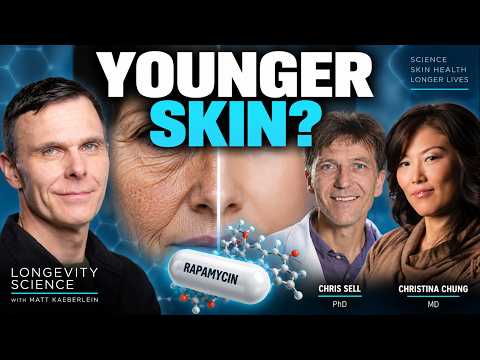
 Plays from YouTube when you click
Matt Kaeberlein · October 12, 2026 · 59:45 · 9,476 views
Topical sirolimus for skin aging: founders interviewed: the main claim
Sirolimus applied to the skin can make aging skin look and behave younger by targeting senescent cells, and a prescription product for it is worth building.
Verdict: a pleasant, honest-sounding conversation that is also a founder pitch, and it should be read as one. The strongest evidence in it is an exploratory placebo-controlled trial of 36 adults over 40 that found lower p16INK4A protein (P = 0.008) and higher collagen VII (P = 0.0077) in treated skin. The guests present those slides as the moment they decided to build a company. They do not say that 19 of the 36 participants dropped out or were lost.
The dermatologist guest brings the most useful material: transplant patients on oral sirolimus-type drugs, who are managed carefully because the drugs slow wound healing and the guest says the drugs are not started right after a transplant for that reason. That fits the label, which warns about impaired wound healing and fluid accumulation. It is a good reminder that even a topical story sits on top of a drug with systemic effects.
What a viewer should take away: the cell results are real but early, the human skin evidence is one trial with biomarker endpoints, and nothing in the video shows that topical use is safe for years or that the oral-use literature applies.
Topical sirolimus for skin aging: founders interviewed: what holds up
- Explains why transplant medicine knows the skin side of sirolimus well: patients on it get skin changes and have been studied for years. The label supports the caution about wound healing in that population.
- Describes cultured human fibroblasts looking healthier after treatment. Cell-culture results of this kind exist, and a yeast study shows the lifespan effect depends on the drug binding its target, which is why a cell-level story is plausible.
- Cites changes in p16INK4A and collagen VII in treated skin. That matches the exploratory trial of 36 adults, where p16INK4A fell (P = 0.008) and collagen VII rose (P = 0.0077). Source
Topical sirolimus for skin aging: founders interviewed: what it skips or gets wrong
- Does not say how many people finished the trial. Of 36 enrolled, 19 discontinued or were lost to follow-up, so fewer than half completed. Endpoints were skin biomarkers, not wrinkles or skin function. Source
- Tells a story of a relative treating one hand with active cream and the other with placebo and a child noticing. That is a charming anecdote, and it is one person, unblinded in practice, with a visible result.
- Sells the idea that skin is a neglected aging target. The human evidence for any aging benefit is very limited; the main human trial of oral use in healthy adults had a null primary outcome. Source
- Skips safety beyond the skin. Systemic absorption, long-term use and sun exposure are not covered, and the topical trial gives no guide to oral use.
Topical sirolimus for skin aging: founders interviewed: strengths and weak spots
Strengths
- Dermatologist adds a clinical view of transplant patients
- Candid about the difficulty of getting a drug approved
- Clear on what a biomarker is versus a visible change
Weak spots
- Guests profit if the product works
- The trial dropout rate is not mentioned
- No evidence given for long-term topical safety
Topical sirolimus for skin aging: founders interviewed: our recommendation
Watch the dermatologist's account of transplant patients and skip the business half. Read the 2019 exploratory trial before believing any skin claim.